
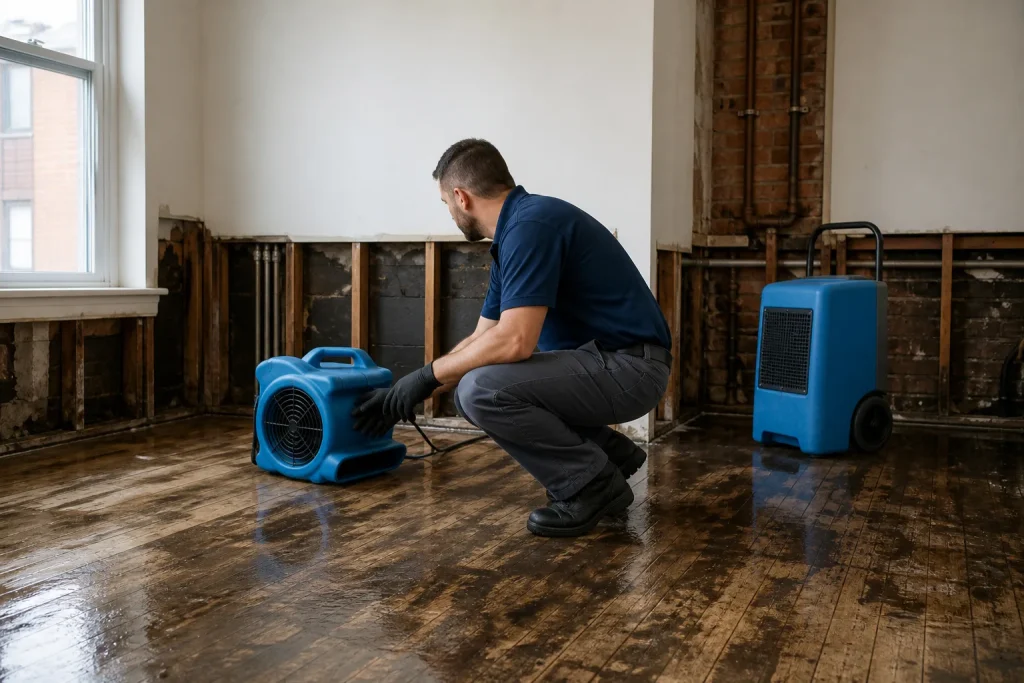
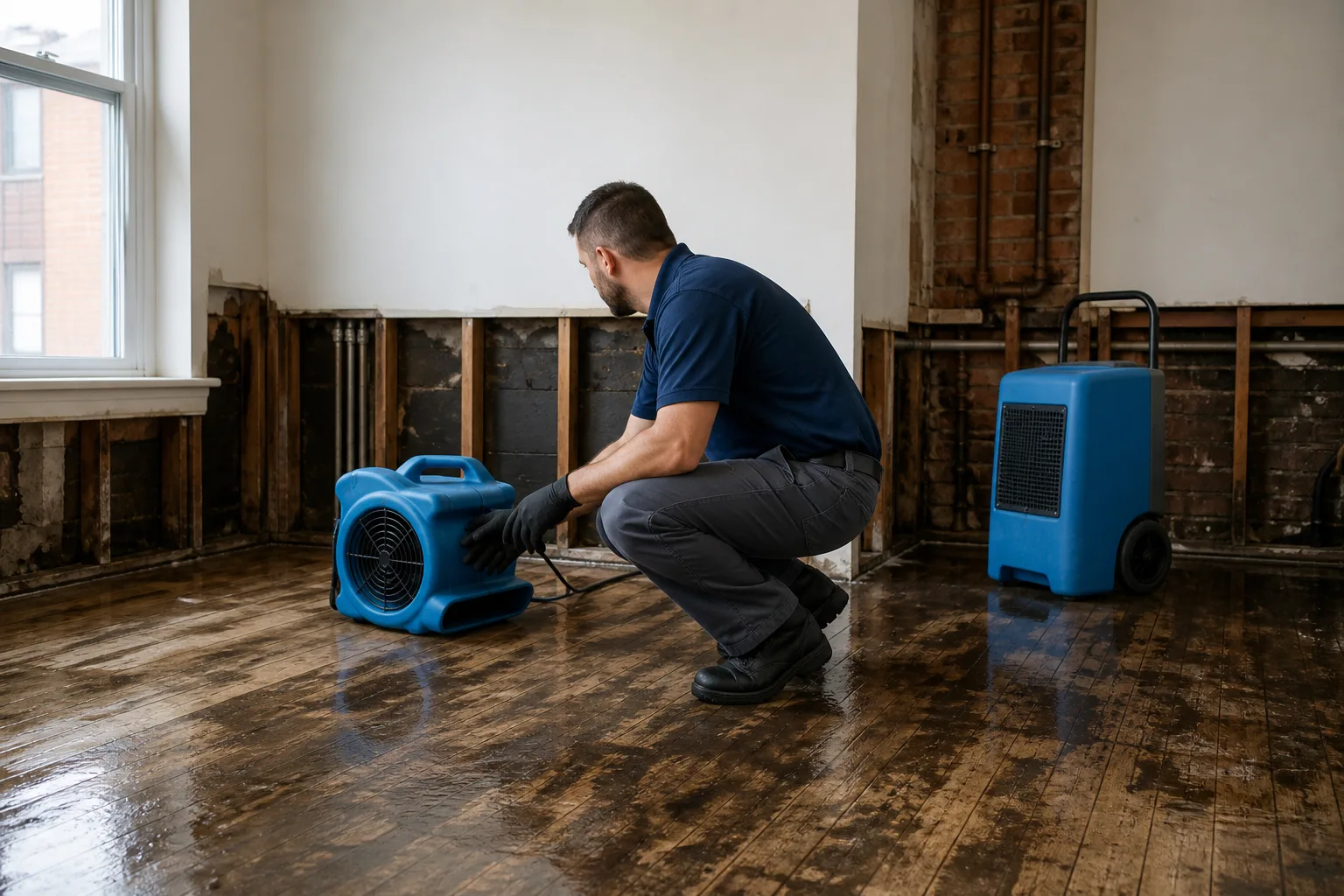
How to Choose the Right Damage Restoration Company in Hoboken
Most “how to choose” guides miss the question that actually matters: after the water is extracted and the fans come out, who rebuilds your walls, and are they on the same contract? Here’s the short version: choose a company that handles mitigation and reconstruction under one roof, bills your insurance carrier directly, and puts its guarantee in writing. If you’d rather not sort through the fine print yourself, call (640) 500-3278 and we’ll walk you through it.
Here is what the generic checklist misses: a company can hold every IICRC credential in the catalog, respond in 45 minutes, and have 200 five-star reviews, and still hand your job to a separate general contractor after the dehumidifiers come out, leaving you to manage two contracts, two timelines, and two sets of warranty disclaimers while the insurance carrier pays on a split invoice nobody fully owns. We see the result of that handoff in Hoboken walk-ups all the time: a homeowner with drywall dust on the stairs and a stack of text messages from two different crews, neither of whom will own the punch list.
The Question That Separates the Real Companies From the Pass-Along Shops
Before you sign anything, ask this: “Who performs the rebuild, and are they on the same contract as the mitigation crew?”
Write it down. Ask it on a recorded line if you want. The answer tells you more than any review ever will.
A company that says “we partner with a great GC” is telling you, politely, that accountability ends at the waterline. Once the drying equipment comes out, their contract is satisfied, their lien rights are preserved, and your rebuild is someone else’s problem. You are now the general contractor for your own home, coordinating schedules, chasing permits, and translating between two crews who have never met.
A company that answers “our crew handles it, same contract, same warranty” is structurally different. They can’t blame the other guy. They can’t claim the mold came back because the rebuild was someone else’s scope. They own the entire job from first extraction to final coat of paint.
What to get in writing: a single scope document that covers extraction, drying, demo, rebuild, and finish, with one signature line and one named project manager.
Hoboken Licensing: What NJ Actually Requires
New Jersey requires a Home Improvement Contractor (HIC) registration through the Division of Consumer Affairs for any company doing residential work over $500. That part is table stakes. But restoration work in Hoboken sits in a gray zone between home improvement and specialized remediation, and the licensing picture shifts depending on what the job involves.
For water extraction and drying alone, the HIC registration plus IICRC-certified technicians generally covers you. For structural reconstruction in a multi-family building, which describes most of Hoboken’s housing stock, the company needs to carry the right builder classification, and the building itself triggers additional requirements: Hoboken’s construction office requires permits for any work that touches structural framing, egress, or life-safety systems.
Ask the company directly: “Show me your NJ HIC number and tell me who pulls the permits for the rebuild.” If they fumble that answer, keep looking.
We hold our own credentials and pull our own permits. One contract, one crew, one accountable name.
Direct Insurance Billing Is a Structural Difference, Not a Convenience
A lot of homeowners think direct billing just saves them paperwork. It does more than that. It shifts liability.
When a restoration company bills your carrier directly and communicates with the adjuster on your behalf, the contractor has a financial relationship with the insurance company. That means scope gaps, supplement requests, and line-item disputes land on the contractor to resolve, not on you at your kitchen table with a highlighter and a three-day-old estimate.
When the homeowner pays out of pocket and chases reimbursement, every gap in scope becomes the homeowner’s problem. The contractor gets paid and walks. The carrier says the drying log wasn’t sufficient. The homeowner is stuck in the middle, which is exactly where the split-contract model wants you.
Ask the company: “Will you bill my carrier directly, and will you document the scope in a way the adjuster will accept?” Then watch how quickly they answer.
In Hoboken, where many buildings are older and claims involve pre-existing condition disputes, having a restoration company that speaks adjuster is worth real money.
Read the Moisture Log Before You Hire
Here’s a vetting trick that costs you nothing and tells you everything: ask to see a sample moisture log from a completed job.
A company that takes drying seriously will show you psychrometric data, daily readings from multiple rooms, humidity and temperature charts, and a final dry standard with the homeowner’s signature. A company that treats drying as an afterthought will show you a one-page form with three checkboxes.
The moisture log is the paper trail that proves the job was done. Without it, you’re taking someone’s word that the walls are dry behind the baseboards. With it, you have a record you can show your adjuster, your mortgage company, and the next buyer of your home.
We run Dri-Eaz and Phoenix equipment with daily logged readings until the dry standard is met, and we hand that log to the homeowner and the carrier. It’s not a favor. It’s how you prove the work.
What a Written Guarantee Should Actually Contain
Most restoration warranties are decorative. They say “90-day satisfaction guarantee” and then the fine print excludes everything that actually goes wrong.
A guarantee worth the paper it’s printed on includes four things: scope, timeline, callback conditions, and remedy.
Scope means the guarantee names what was repaired: “all drywall replacement, baseboard installation, and painting performed under this contract.” Timeline means the guarantee has a start and end date in writing. Callback conditions means it says what happens if you find an issue: “homeowner notifies contractor in writing within 90 days; contractor responds within 5 business days.” Remedy means it says what the fix looks like: “contractor will correct the defect at no additional cost.”
If the guarantee lacks any of those four elements, it’s a marketing sentence, not a warranty.
Our 90-Day Done Right Promise, the Keystone Standard, says exactly what we’ll do if something isn’t right: we make it right. No paperwork battles, no arguing. It’s in writing because a handshake is a nice gesture and a contract is a real one.
The Single-Visit Standard and Why It Matters
Some restoration companies treat the first visit as triage: extract water, drop equipment, leave. Then a different tech comes the next day for readings, and a third person handles the rebuild estimate, and you’re keeping a mental org chart of who does what.
The better model, and the one we run, is the single-visit standard. The same certified crew that reads the moisture map on day one handles the daily readings, keeps the log, and rebuilds what needs rebuilding. Most jobs are completed in a single visit because the person holding the moisture meter on Tuesday morning is the same person who hung the drywall on Friday.
Why this matters for choosing a company: a firm that sends one crew through the entire job has institutional memory. They know which stud bay was wet. They know where the baseboard was swelling. They don’t need a handoff memo to understand your house.
Ask: “Will the same crew handle this from start to finish, or does it get handed between teams?” The answer shapes how much you’ll be managing.
The Hoboken-Specific Reality Check
Hoboken is not the suburbs. We work in attached rowhouses, prewar walk-ups, and condo buildings where a burst pipe on the fourth floor is a problem for the third-floor ceiling, which is a problem for the second-floor owner’s insurance claim, which is a problem for the HOA’s master policy. Water moves laterally through party walls and floor joists in ways a standalone house never sees.
A restoration company that works in Hoboken should know what a party wall easement means, what the building’s insurance certificate requires, and how to coordinate with a co-op board that wants three bids and a notarized scope before the truck parks out front.
We’ve pulled equipment out of garages on Washington Street and chased moisture through floor joists in buildings older than the Williamsburg Bridge. The line the water left is where we start, and in Hoboken that line is rarely a straight one.
Related Services in Hoboken
If you’re already staring at a wet ceiling, start with our Water Damage Restoration in Hoboken page. If you smell something musty but can’t see water, read about Mold Remediation in Hoboken. And if a fire left more than visible soot, our Fire & Smoke Damage Restoration in Hoboken coverage explains the full approach. The Floodline Restoration Co. home page has everything in one place.
What happens when you call
- 1
A real person answersNo phone trees - you reach a local pro.
- 2
You get an upfront price rangeHonest numbers before anyone is dispatched.
- 3
A background-checked tech heads outLicensed & insured, dispatched right away.
- 4
You approve before work beginsNothing starts until you say go.
The Bottom Line
Choosing a restoration company in Hoboken comes down to four questions: Who does the rebuild, and are they on the same contract? Will you bill my carrier directly? Will you show me a real moisture log? And what does your written guarantee actually say?
If a company answers all four cleanly, you’re talking to a contractor who plans to be accountable after the drying equipment leaves. If they dodge, stall, or say “we partner with someone,” you’re interviewing the first act of a two-act problem.
If you’re in Hoboken and need help now, Floodline Restoration Co. offers free estimates. Call (640) 500-3278 and a live person answers, day or night.
Frequently Asked Questions
How do I know if a restoration company is actually qualified?
Ask for their NJ Home Improvement Contractor registration number, confirm their technicians carry IICRC certification, and ask who pulls permits for structural rebuild work. Then ask the question that matters: “Are mitigation and reconstruction on the same contract?” A qualified company answers without hesitation.
Will my insurance cover the full cost of restoration?
It depends on your policy, your deductible, and the cause of the damage. What matters most is whether the restoration company bills your carrier directly and documents the work to the adjuster’s standard. Direct billing shifts scope disputes from you to the contractor, which is where they belong. Call (640) 500-3278 if you want us to review your situation.
How fast can a restoration company actually get to my house in Hoboken?
A truly local company with live dispatch should reach most Hoboken addresses within an hour of your call, even at 2 a.m. That’s why we staff a live dispatcher around the clock, not a voicemail. Extraction that starts the same visit stops the damage from spreading into walls, floors, and the unit below you.
Do I really need full restoration, or can I just dry it out myself?
If water sat for more than a few hours or wicked into drywall, baseboards, or flooring, you need professional drying with moisture-mapped equipment. Surface drying alone leaves hidden pockets that grow mold inside wall cavities. In Hoboken’s attached buildings, that mold travels to your neighbors. Get a professional assessment before you decide. Call (640) 500-3278 for a straight answer.
Written by Curt Bowman, Owner at Floodline Restoration Co., serving Hoboken since 2010.
Need Damage Restoration Help?
Call Floodline Restoration Co. - licensed & insured, here with fast after-hours help in Hoboken.
(640) 500-3278