
Emergency Water Damage Restoration Near Me: What Hoboken Homeowners Should Do First
If water is spreading through your Hoboken home right now, the first call should be to a restoration crew that can get extraction equipment running within the hour, not to your insurance company’s voicemail. The first 90 minutes determine whether you’re looking at a $4,000 drying job or a $40,000 mold-and-rebuild claim. If you’d rather not handle this yourself, call Floodline Restoration Co. at (640) 500-3278 and a live dispatcher will answer, any hour.
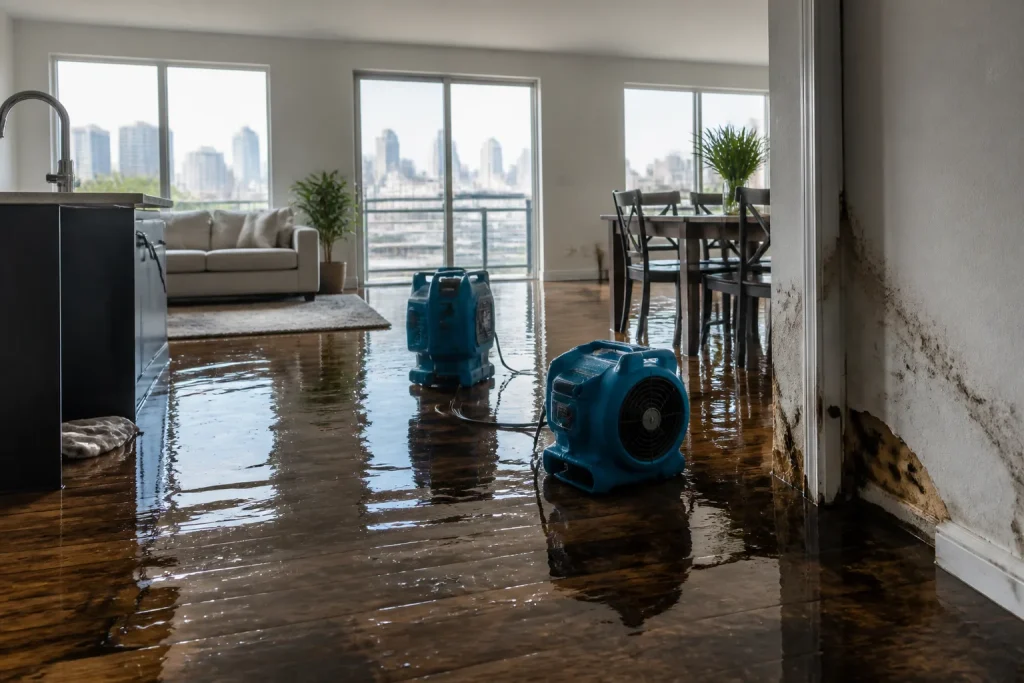
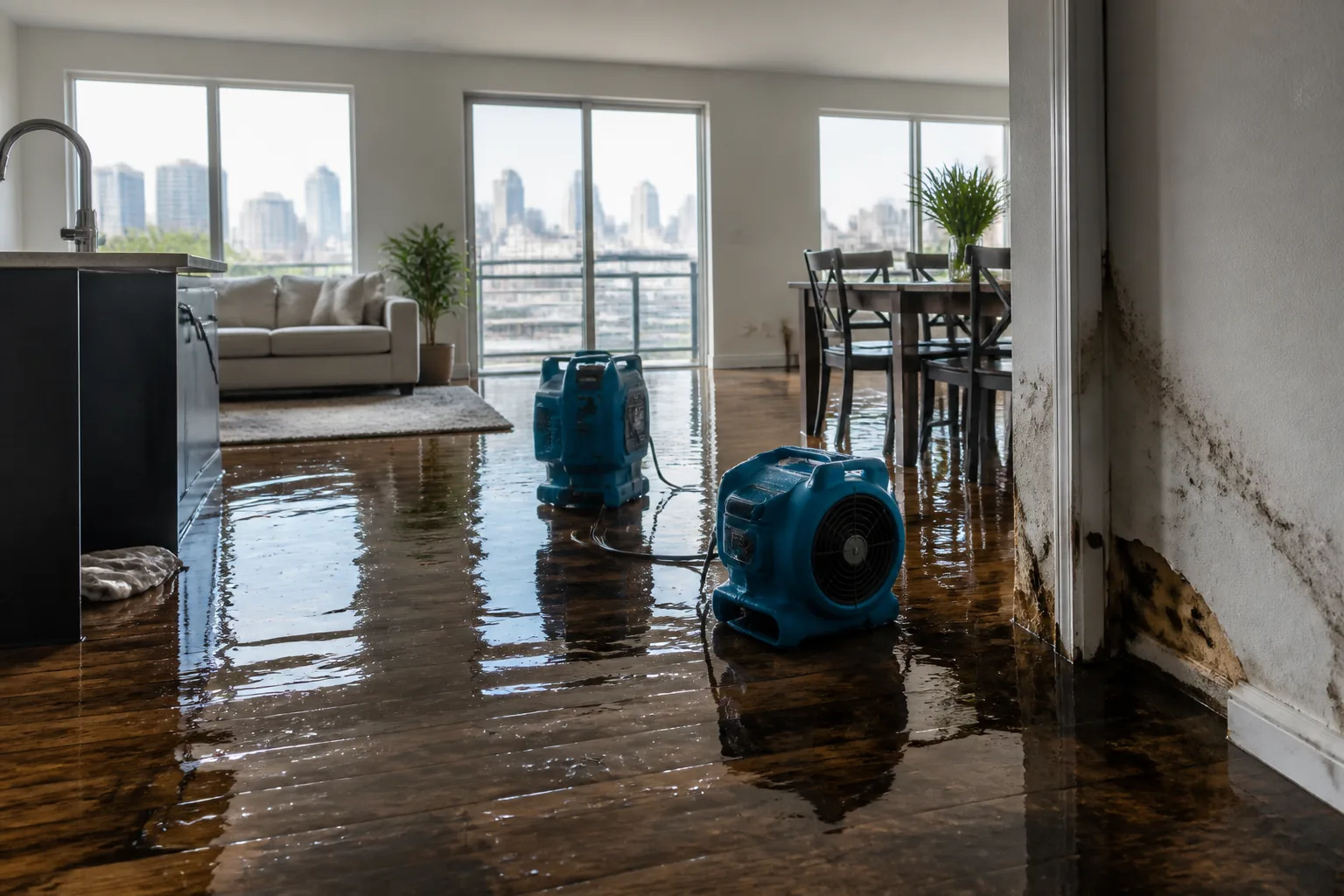
Running a box fan into a water-damaged room feels productive. In a Hoboken row house in July, with 78% ambient humidity, that fan is moving saturated air from your living room into your wall cavities and accelerating secondary damage. The right move in the first hour isn’t airflow. It’s containment, documentation, and a moisture reading from someone who knows what category the water is.
Why the First 90 Minutes Matter More in Hoboken Than Almost Anywhere Else
Hoboken’s housing stock is dense. Most homes share at least one party wall, and many share two. When a supply line lets go on the third floor of a brownstone, water doesn’t just move down through your unit. It moves laterally into the wall cavities, follows the joist bays, and finds its way into the neighbor’s ceiling before you’ve finished soaking up the visible puddle with bath towels.
We’ve walked into Hoboken homes where the homeowner called us within forty minutes of noticing the leak, and the neighbor’s ceiling was already staining. That’s not because the homeowner was slow. It’s because the building was built in 1910, the plaster and lath wicks moisture like a sponge, and there’s no fire-blocking or modern vapor barrier to slow lateral migration. The water found the path of least resistance, and that path ran horizontally.
Here’s what that means for you. If water from your unit damages the unit next door, you may have a liability claim against your policy or against you personally, depending on the source and your by-laws. That’s a clock you don’t control. The only clock you control is the one that starts the moment you notice water: how fast you get a certified crew reading moisture and running extraction.
In our experience, the homeowners who fare best after a Hoboken water event do three things in the first hour: they shut off the water source, they document everything with photos, and they call a restoration company before they call the insurance carrier. We’ll walk through each of those below.
Stop Guessing About Water Category: Category 1 vs. Category 3 Changes Everything
Before you touch anything or let anyone else touch anything, figure out what kind of water you’re dealing with. The IICRC, the standard-setting body for restoration work, divides water into three categories. Knowing which one you have changes every decision that follows, including whether you can safely keep any of your belongings.
Category 1 is clean water from a sanitary source: a supply line to a sink, a tub overflow, a refrigerator line, a water heater tank. If the water is clear, came from a pipe or fixture, and hasn’t sat around for more than 48 hours, it’s likely Category 1. The good news is that many Category 1 losses can be dried in place. Carpet, padding, drywall, and baseboard can often be saved if extraction starts fast and drying equipment gets installed properly.
Category 2 is “gray water,” which means water with some contamination: dishwasher discharge, washing machine overflow, sump pump failure. This water carries detergents, food particles, or soil, and it can support bacterial growth quickly, especially in a Hoboken basement in August.
Category 3 is grossly contaminated water: sewage, rising floodwater from outside, storm surge, or any water that has sat long enough to support microbial growth. This is the category that requires the most aggressive response. Carpet and padding contaminated with Category 3 water is generally removed and disposed of, not dried. Hard surfaces get cleaned and disinfected to a specific standard. If you’re not sure which category you have, treat it as the worse one until a certified technician tells you otherwise.
Why does this matter for the homeowner on the phone at 2 a.m.? Because a water-vacuuming service with a logo on the van might not make this distinction at all. They’ll pull the standing water and leave. A certified crew determines the category, measures how far the water migrated, and then builds a drying plan around that data. That’s not a formality. It’s the difference between a room that dries clean and a room that smells like mildew every humid August for the next five years.
Your Documentation Sequence: What to Photograph Before You Touch Anything
This is the step most Hoboken homeowners skip, and it’s the one that protects you the most when the claim gets opened. Your phone is already in your hand. Use it.
Photograph in this order:
- The source first. The burst supply line, the failed water heater, the overflowing tub. If the source is inside a wall and you can’t see it, photograph the area where water is emerging and mark the time.
- The standing water. Wide shots of each affected room from the doorway, before you step in and disturb the water line. That water line on the drywall is evidence of how high the water rose, and it matters for scope.
- The materials affected. Baseboards, carpet edges, cabinet bases, door casings. Anywhere water is touching or has touched. Get close enough that a claims adjuster can see the material and its condition.
- The adjacent spaces. The room below the leak, the closet on the other side of the wall, the hallway. In Hoboken attached buildings, photograph the shared wall area too, especially if you suspect water migrated toward a neighbor.
- The serial numbers. If an appliance failed, photograph the make, model, and serial number plate. That documentation speeds the appliance portion of your claim.
Then and only then, after you have a complete photo record, call a restoration company and start the clock on mitigation. The photo set becomes part of your claim file, and a good restoration company will add its own moisture-mapping documentation on top of it.
One more note. Do not move large furniture, pull up carpet, or start cutting anything before the documentation is done. Not because it’s forbidden, but because you’ll disturb the evidence that tells the true story of what happened. Let the photos tell that story first.
Why Calling Your Insurance Company First Is the Wrong Sequence
This is counterintuitive, and it’s the piece of advice that surprises most Hoboken homeowners when we explain it. Your instinct is to call the carrier, open the claim, and get the process moving. That instinct is understandable. But in most water events, it’s sequenced incorrectly.
Here’s the problem. The carrier’s first question will be: “What’s been done to stop the damage?” If your answer is “nothing yet, I called you first,” then the carrier has a recorded statement from you confirming that mitigation hadn’t started. Then the drying process takes longer, secondary damage sets in, and the claim grows. The carrier is not your adversary, but they’re also not going to dispatch a crew to your house. Your policy requires you to mitigate damages promptly. That duty is on you, not on the carrier.
The correct sequence in most Hoboken scenarios looks like this:
- Stop the water at the source if you can safely do so.
- Photograph everything in the order described above.
- Call a restoration company. We answer live at (640) 500-3278, 24 hours a day.
- Start extraction and drying. The crew brings professional-grade equipment-we run Dri-Eaz, Phoenix, and XPOWER units-and gets the structure drying the same visit.
- Notify your carrier. After mitigation is underway, you call your agent or carrier’s claims line with a clear, accurate account: “We had a supply line failure at 6 p.m., I documented everything, Floodline Restoration Co. is on site now with extraction running.”
That sequence protects your policy obligations and your claim. You’ve mitigated, you’ve documented, and the carrier has a clear picture. We also carry photo documentation and daily moisture readings that we provide directly to the adjuster, which keeps the claim moving without you playing messenger.
Need help right now? Call (640) 500-3278 and a live dispatcher will walk you through this on the phone.
Before the Crew Walks Through Your Door: Three Questions to Ask
Not every company that shows up to a water event in Hoboken is the same. Some are restoration companies. Some are water-vacuuming services with a logo. You can tell the difference in sixty seconds by asking three questions, and you should ask them before anyone crosses your threshold.
Question one: “Are your technicians IICRC-certified, and can I see credentials?” The IICRC is the body that sets the standards for water damage restoration. Certification means the person running your drying plan has been trained to a national standard. Our technicians are IICRC, RIA, and IFA certified, background-checked, and uniformed. If the answer to this question is vague or defensive, that tells you something.
Question two: “Will you moisture-map the affected area and give me daily readings?” A legitimate drying plan starts with a moisture map: a room-by-room, wall-by-wall record of where the water is and how much. Then someone reads those same locations every day until the drying standard is met. If a company can’t describe their moisture-mapping process, they’re guessing, and guessing is expensive. We provide a moisture log to the homeowner and the carrier. You see every reading.
Question three: “Do you bill the carrier directly, or am I the billing middleman?” The answer to this one tells you a lot about how the claim will feel over the next few weeks. We bill the carrier directly. You don’t write a check and wait for reimbursement. You don’t carry a balance while the adjuster reviews line items. The paperwork moves between us and the carrier, and you get a copy.
Ask those three questions. If the company answers all three clearly and in writing, you’ve probably got a real restoration crew. If they waffle on any of them, call someone else.
We pulled one out of a third-floor walk-up over near Church Square Park last month where the homeowner had already called two other companies. Both gave her a price over the phone without seeing the job. By the time we arrived, the water from her bathroom supply line had migrated down into the second-floor unit’s kitchen ceiling. The other two companies never asked about the neighbors. That’s the difference between a dispatch board and a sales desk.
What Actually Happens During the First 24 Hours of Professional Restoration
Here’s what a certified response looks like when it’s done correctly, step by step, so you know what to expect when the crew arrives in Hoboken.
First hour. The crew determines the water category, maps the affected area with moisture meters, and positions extraction equipment. In a Hoboken brownstone, that means checking the floor below, the shared wall, and the joist bays, not just the room where you saw the puddle.
Hours two through six. Standing water is extracted. Wet carpet and padding are removed if they’re unsalvageable. Baseboards may be pulled in affected areas. The goal is to get the structure as dry as possible before drying equipment is installed.
Hours six through twenty-four. Air movers and dehumidifiers go in. We use professional-grade Dri-Eaz and Phoenix dehumidifiers, and the placement is based on the moisture map, not on guesswork. The equipment runs continuously. Depending on the category of water, antimicrobial treatment is applied to affected surfaces.
Then, daily. The crew returns each day to take moisture readings at the same mapped locations. The readings get logged. You see the log. When the drying standard is met, the equipment comes out, and the rebuild conversation begins if anything needs to be reconstructed.
Most water jobs in Hoboken are completed in a single visit for extraction, with drying completed over the following days. The same crew that reads the moisture map on day one handles the daily readings. No mid-job handoff to a crew you’ve never met.
When to Call a Pro (and When You Can Wait)
If the water event is small enough that you can soak it up with towels in ten minutes and the area is fully dry within a day, you may not need a restoration company. A spilled glass of water, a small drip from a sink cabinet that you catch quickly, a bathroom overflow from clean water that you contain immediately-these are homeowner-level events.
You need a professional crew when any of these apply:
- The water covered more than a single room or is wicking up drywall.
- The water came from a sewage line, a sump pump, or outdoor flooding (Category 2 or Category 3).
- The water has been sitting for more than a few hours.
- You can smell mildew or see staining that suggests the leak has been going on longer than you realized.
- You live in an attached Hoboken building and water may have reached a party wall or the unit below.
- You’re not sure what you’re dealing with, and you’d rather have a certified answer than a guess.
If you’re in Hoboken and you’re not sure, call (640) 500-3278. A live person answers, and we’ll tell you honestly whether this is a job you need us for or something you can handle with a fan and a mop. That honest answer doesn’t cost you anything.
Related services in Hoboken: Water Damage Restoration in Hoboken covers full extraction, drying, and rebuild. If water has been sitting long enough for mold to start, see Mold Remediation in Hoboken. And if you’re here because of a fire suppression system discharge or a kitchen fire, we also handle Fire & Smoke Damage Restoration in Hoboken. Everything under one roof, from first extraction to finished rebuild, at Floodline Restoration Co. home.
The Bottom Line
The first 90 minutes after a water event in Hoboken determine how big this claim becomes. In dense, attached buildings, water moves laterally and vertically faster than most homeowners expect, and the neighbor’s ceiling is often the first notification that the problem is bigger than one room. Document before you touch. Call a certified crew before you call the carrier. Ask the right questions before the crew walks in.
Floodline Restoration Co. has been serving Hoboken since 2010. We answer our phones with a live dispatcher 24 hours a day, we moisture-map every job, we bill your carrier directly, and we back every job with the 90-Day Done Right Promise in writing. If you’re in Hoboken and you need help, call (640) 500-3278 for a free estimate. The line the water left is where we start.
Currently offering $50 off any repair over $250, an $89 seasonal tune-up, and a permanent 5% discount for seniors and veterans.
Frequently Asked Questions
Floodline Restoration Co. answers the phone with a live dispatcher 24/7, and our certified crew reaches Hoboken homes the same visit. We don’t use answering services. Call (640) 500-3278 and you’ll speak to a person who can dispatch a crew immediately.
Most Hoboken homeowner policies cover sudden and accidental water damage from sources like supply line failures, water heater ruptures, and appliance malfunctions. Coverage for gradual leaks and flood damage varies by policy. We photograph and document everything, we bill your carrier directly, and we send your adjuster a daily moisture log so the claim moves cleanly. Call (640) 500-3278 and we’ll help you understand your coverage before you file.
That depends on the water category, how far it migrated, and how long it sat. In Hoboken’s attached homes, what looks like a one-room problem often becomes a multi-level drying job once moisture readings come back. We tell homeowners honestly when the job is small enough to handle themselves. When you call (640) 500-3278, you’ll get a straight answer, not a sales pitch.
We do. Floodline Restoration Co. provides your adjuster with the initial moisture map, daily drying readings, and a written scope of work. You’re kept informed, but you’re not the messenger running paperwork between us and the carrier. That’s part of the 90-Day Done Right Promise, and it’s in writing.
Written by Curt Bowman, Owner at Floodline Restoration Co., serving Hoboken since 2010.
Need Damage Restoration Help?
Call Floodline Restoration Co. - licensed & insured, here with fast after-hours help in Hoboken.
(640) 500-3278