
RIA Water Damage Restoration in Hoboken: A Homeowner’s Guide
RIA water damage restoration standards set the benchmark for how professionals dry structures, but in Hoboken they need translation, not blind application. The RIA’s S500 drying goals assume “normal moisture content” that simply doesn’t exist in a 1903 brownstone with original brick and old-growth timber. If you want restoration done right here, you need a crew that reads RIA protocols through a Hoboken lens, not a generic suburban one.
If you’d rather not spend your weekend learning psychrometrics, call (640) 500-3278. We’ll handle the standards so you can handle your life.
The RIA Standard: What It Actually Says, and What It Misses in Hoboken
The Restoration Industry Association’s S500 guideline is the most respected drying standard in the business. It defines how to categorize water damage, how to set drying goals, and what “dry” means before a project closes. The core idea: return affected materials to their pre-loss moisture content, known as the dry standard.
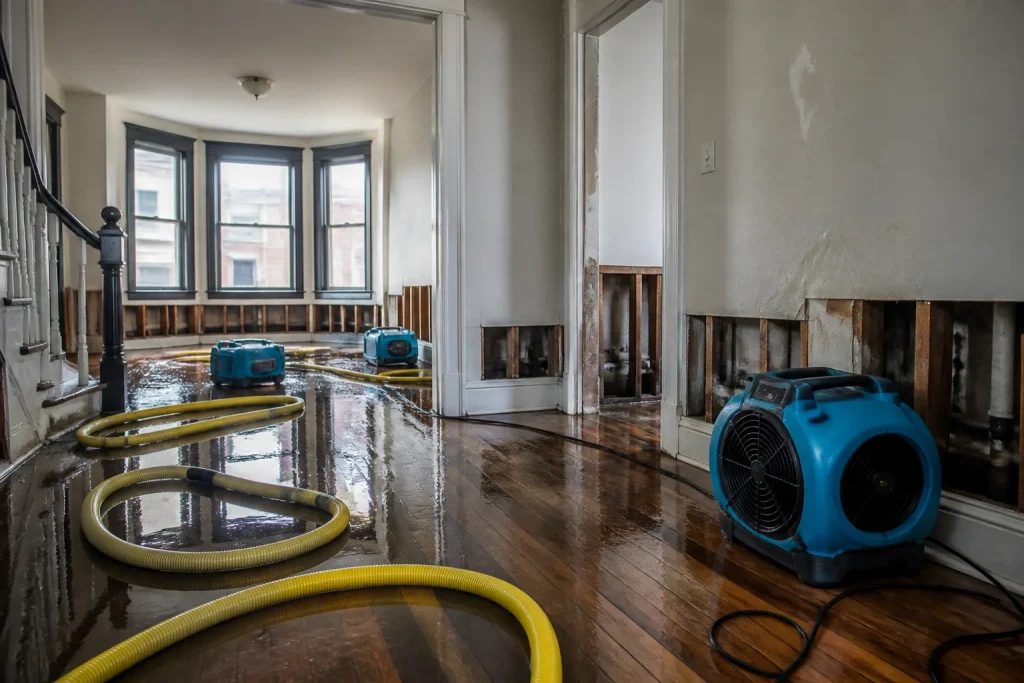
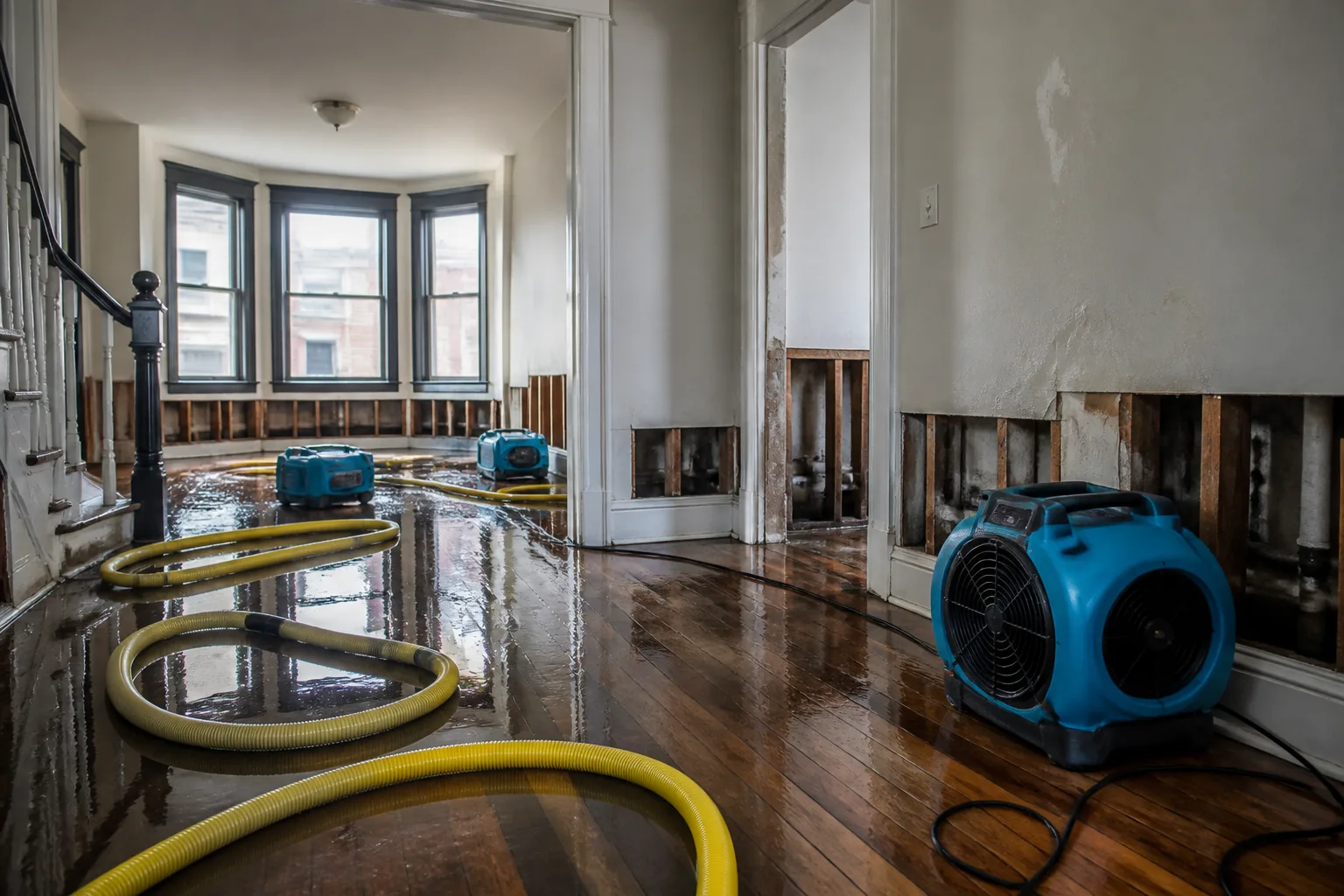
Here’s the problem for Hoboken homeowners. The dry standard assumes you’re working with modern dimensional lumber and drywall. In our experience, the majority of Hoboken’s housing stock predates 1940. The original brick party walls, thick plaster, and dense old-growth floor joists hold moisture differently than anything in a 2005 subdivision. Old-growth pine absorbs water slower and releases it slower. Brick acts as a reservoir. Plaster over lath traps humidity for weeks.
A technician who treats a Hoboken row house like a suburban split-level will set drying goals too low, pull equipment too early, and hand you a certificate that says “dry” when the walls are still quietly wicking. That’s not a paperwork problem. That’s a mold problem six months later.
Why Party Walls Change Everything
Attached brownstones share walls. That’s obvious. What’s less obvious is how those party walls behave during drying. When water migrates laterally, it doesn’t stop at the property line. The masonry has capillaries. Moisture moves sideways through brick and mortar, sometimes into the neighbor’s side, sometimes back into yours after you thought the job was done. This is a real phenomenon we deal with on Washington Street and throughout the historic districts. A standard psychrometric reading on your side says the wall is at 11% moisture content. But the neighbor’s side, or the inner core of the masonry, is still saturated at 18%. Take the equipment out and that moisture equalizes right back into your freshly “dried” wall.
RIA’s S500 does mention checking hidden cavities. It doesn’t specifically address the lateral migration pattern of attached pre-war construction in a dense urban environment. That’s where experience in Hoboken matters. It’s not enough to read a meter on the surface. You need to know what’s inside a 115-year-old party wall and how long Hoboken’s climate keeps brick from releasing moisture. We’ve seen walls that took three weeks to dry properly, not three days. Rushing it means redoing it.
Below-Grade Basements and the Hudson River Factor
RIA classifies water damage into three categories: Category 1 is clean water, Category 2 is contaminated, Category 3 is grossly unsanitary. The classification drives the restoration protocol. A clean-water pipe break gets extraction and drying. Category 3 sewage backup requires removal of affected materials and sanitary treatment.
Hoboken complicates this. Much of the city sits below grade in areas that were once marshland, a fact anyone who owns a basement on the west side knows. Groundwater intrusion through foundation walls, or a high water table after heavy rain, can bring contaminates like silt, petroleum residue from old buried tanks, and storm-sewer overflow into a basement that looks like it just got wet. RIA would classify some of this as Category 1 if the source is rainwater. The groundwater reality in Hoboken pushes many of these jobs toward Category 2 or 3 conditions. We treat them accordingly, even when a check-the-box classification would let us do less. It’s the difference between drying a basement and sanitizing it.
Homeowners should ask a direct question: What category does this water fall under, and why? If the answer doesn’t mention Hoboken’s water table or the age of your foundation, get a second opinion.
What a Compliant Moisture Log Actually Looks Like
RIA standards require documentation. A professional restoration company should track daily moisture readings, note the drying goal, and record equipment placement. The log is proof the job was done correctly. Without it, you’re taking someone’s word.
Here’s what to demand before you sign any certificate of completion:
- Baseline readings taken within 24 hours of the loss. These establish the starting point and justify the equipment selected.
- A written dry standard for every affected room, based on an unaffected reference material. In Hoboken, that reference should come from the same building, not a generic wood species chart.
- Daily moisture content readings from walls, floors, and framing, including party wall cavities where accessible. If the log shows only surface readings, it doesn’t tell the full story.
- Dry standard confirmation before equipment removal. We don’t pull air movers because a certain number of days passed. We pull them when the meters say the structure is actually dry.
- A signature from the technician who took the readings, with the date and time on every entry.
We hand every homeowner a full moisture log when the job closes. If your contractor hesitates to hand over the log, that’s a red flag bigger than the water stain.
What the Letters Mean: WRT, ASD, AMRT
RIA and the IICRC both offer certification tracks. Asking for “a certified technician” isn’t enough. The letters after the name tell you what that person actually knows. Here’s how they map to Hoboken jobs:
- WRT (Water Restoration Technician): Trained in extraction, drying science, and moisture documentation. This is the baseline credential. Every crew member working on your home should have at least this.
- ASD (Applied Structural Drying): Advanced training in drying complex structures, including wall cavities, subfloors, and hard-to-reach areas. In a Hoboken brownstone with plaster walls and thick masonry, this credential separates a technician who guesses from one who knows where water hides.
- AMRT (Applied Microbial Remediation Technician): Specialized in mold and bacteria removal. In attached homes where a neighbor’s leak can seed mold growth in your wall cavity, AMRT-trained technicians know how to contain and remove it without cross-contaminating the rest of the house.
We’re not saying homeowners should demand credentials at the door before letting anyone in. But asking, “Which of your techs holds WRT or ASD?” is a fair question. A company that can’t answer it isn’t serious about the standards.
When to call a pro: if you see standing water in a basement below the sidewalk line, water wicking up walls in an attached home, or your moisture meter reads above 15% on the drywall two days after a leak, call (640) 500-3278. Getting it wrong now costs more later.
Related services in Hoboken: Water Damage Restoration in Hoboken covers extraction through drying. If water sat for more than 48 hours, Mold Remediation in Hoboken walks through containment and removal. And if a kitchen fire followed a burst pipe, Fire & Smoke Damage Restoration in Hoboken explains the cleanup order.
The Bottom Line
RIA standards are good. They’re just incomplete when applied to Hoboken’s pre-war housing stock without local knowledge. Party walls move moisture sideways. Brick and old-growth timber dry on a different schedule. Groundwater below grade doesn’t follow the category chart. And a moisture log is only worth anything if it includes cavity readings and the right dry standard.
We start every Hoboken job at the floodline, the mark the water left, and we don’t stop until the meters say the structure is dry, the log is in your hand, and the 90-Day Done Right Promise is in writing. If you’re in Hoboken and dealing with water damage, call (640) 500-3278 for a free estimate. A live person answers, day or night.
Frequently Asked Questions
RIA stands for the Restoration Industry Association, the organization that publishes the S500 standard for professional water damage restoration. It’s the reference for how to classify water damage, set drying goals, and document the process. In Hoboken, apply it with local knowledge of masonry and party walls, not as a one-size-fits-all spec.
Most single-room jobs dry in three to five days, but a Hoboken row house with plaster walls, brick party walls, and old-growth joists can take two to three weeks. Our crews use Dri-Eaz and Phoenix equipment with daily moisture readings until the dry standard is met. We don’t rush the log just because the calendar says it’s been a week.
Yes. The moisture log is your proof that drying was done correctly. It should show baseline readings, daily measurements from walls and cavities, the drying goal, and a final confirmation before equipment comes out. If a company won’t provide one, don’t sign the certificate of completion. Call (640) 500-3278 and we’ll explain what a proper log covers.
It matters, but it’s not sufficient by itself. WRT, ASD, and AMRT certifications show technical training. What matters just as much is experience with pre-1940 attached construction. Ask whether the crew has dried brownstones with party walls and below-grade basements before. We have, for over 42 years combined across our leadership, and we’ve been doing it in Hoboken since 2010.
Written by Curt Bowman, Owner at Floodline Restoration Co., serving Hoboken since 2010.
Need Damage Restoration Help?
Call Floodline Restoration Co. - licensed & insured, here with fast after-hours help in Hoboken.
(640) 500-3278